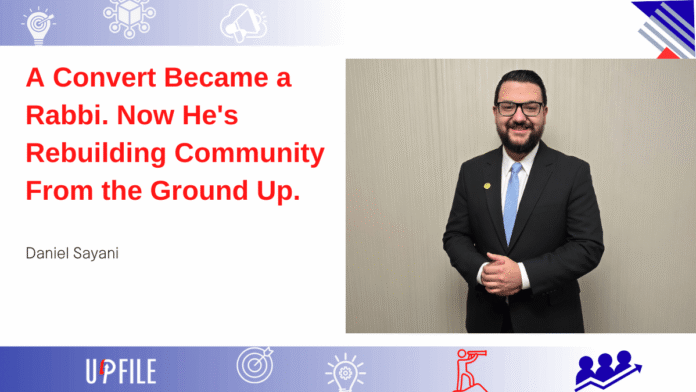

Most people inherit their religious identity. Rabbi Daniel Sayani chose his.
He was not raised Jewish. He came to the faith as an adult and committed fully. Thirteen years after converting, he holds multiple rabbinic ordinations, leads a synagogue founded by Holocaust survivors, and serves Jewish families across Queens and Brooklyn with scholarship, care, and consistent presence.
Nothing about his path was automatic. That is exactly what gives it meaning.
Credentials That Reflect Real Commitment
Rabbi Sayani’s training stretches across years, institutions, and continents. Every qualification was earned through sustained study and recognized rabbinic authority.
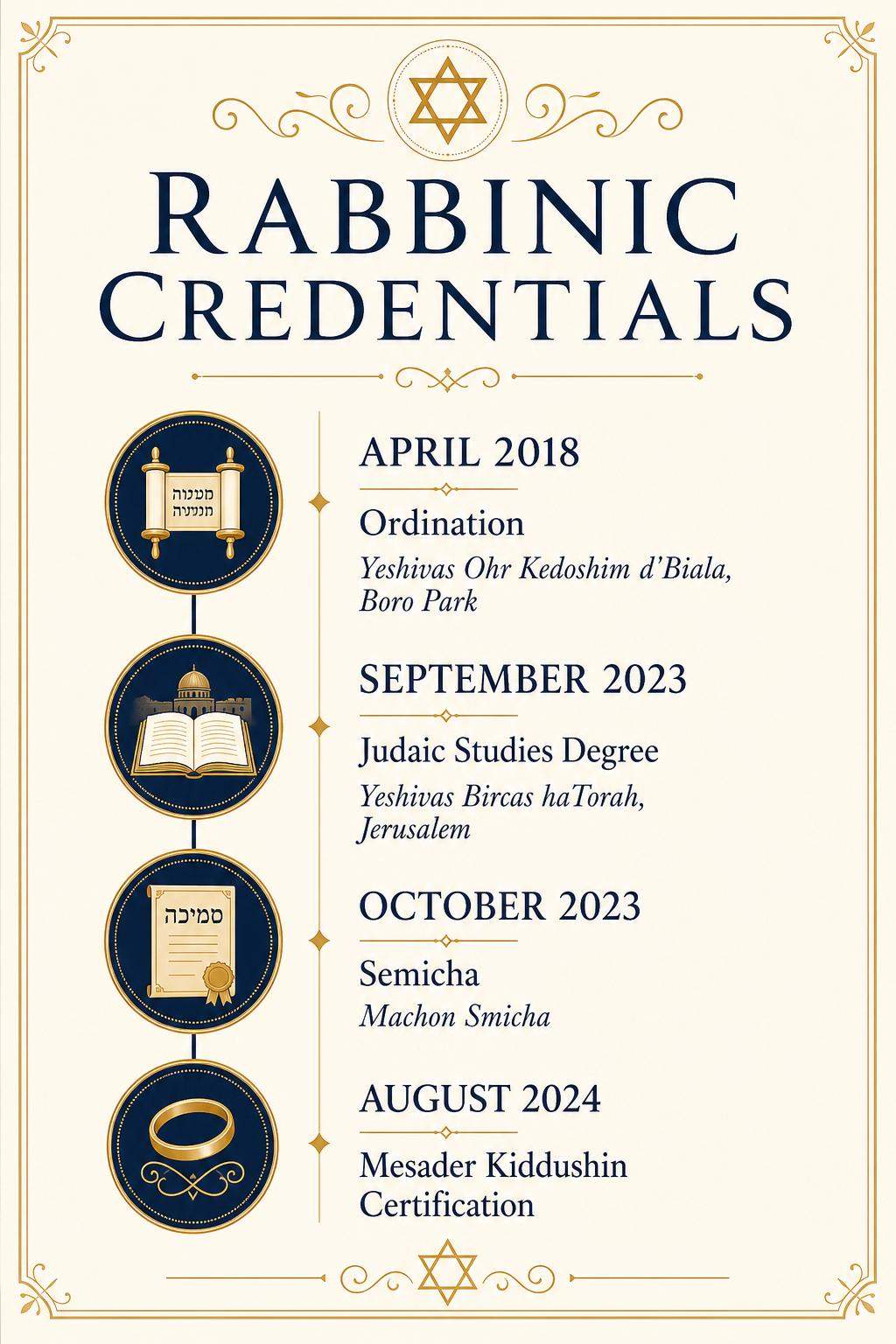
In April 2018, he received ordination as Rav u’Manhig, Moreh Hora’ah from Yeshivas Ohr Kedoshim d’Biala in Boro Park. The yeshiva follows the Biala Chasidic tradition, a lineage centered on warmth and the principle of mevaser tov, finding the good in every person. That spirit shapes how he leads and how he teaches.
He pursued further learning in Jerusalem. In September 2023, he earned a First Degree in Judaic Studies from Yeshivas Bircas haTorah, completing broad and rigorous study across Talmudic and theological subjects. The following month, he received additional ordination through Machon Smicha, with advanced focus on Shabbat law and key areas of kashrut, including melicha, basar v’chalav, and taaruvot. His semicha was conferred under HaRav Chaim Finkelstein, Rosh Yeshiva of Yeshiva L’Rabbonus in Pretoria, South Africa.
In August 2024, he earned certification as a Mesader Kiddushin through Machon Smicha. This credential authorizes him to officiate at halachic Jewish weddings. It was signed by HaRav Dovid Lau, former Ashkenazi Chief Rabbi of Israel, and HaRav Yehoram Ulman, Av Beis Din in Sydney, Australia.
He approaches weddings with genuine seriousness. For him, each ceremony is an opportunity to help couples find real meaning in ancient texts, from the kesuba to the full arc of a halachically structured ceremony.
Readers who want to learn more about his background, community work, and public teaching can visit his official website. A broader collection of his projects and platforms is also available through his Linktree.
Leading a Synagogue With Deep Roots
The Clearview Jewish Center in Whitestone, Queens was established in 1952. Holocaust survivors founded it. That history shapes the congregation’s identity and its sense of responsibility.
Rabbi Sayani became its rabbi in August 2021. He stepped into a community navigating challenges that many smaller New York synagogues know well. An aging membership. Shifting neighborhood demographics. The ongoing work of sustaining Jewish communal life across generations.
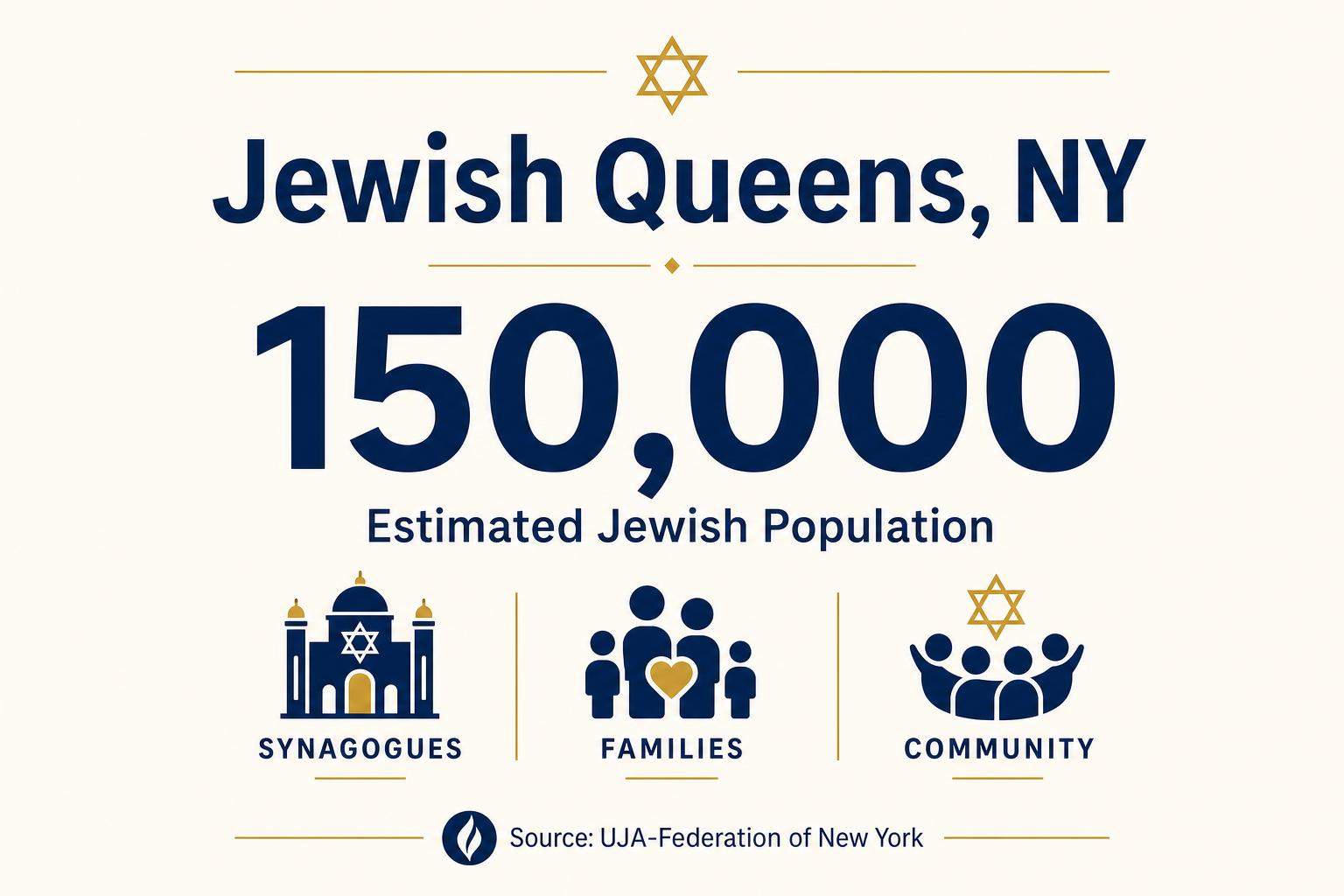
The numbers provide useful context. UJA Federation of New York’s 2023 Jewish Community Study reports that Queens is home to about 150,000 Jewish people, including roughly 126,000 Jewish adults and 23,000 Jewish children. Despite that population, smaller congregations across the borough regularly face questions about attendance, continuity, and building toward the future.
Rabbi Sayani guided Clearview Jewish Center through a transition to full Orthodox observance. A mechitza was installed. The microphone was removed on Shabbat. These were significant steps, and he led them with patience and genuine care for where each member stood.
He also embraced practical tools to keep people connected. Zoom became a consistent vehicle for learning, reaching seniors who found travel difficult and families with demanding schedules. Technology extended the community’s reach without diluting its substance.
His teaching through the Jewish Learning Institute’s Torah Studies program reflects that same balance. He brings classical texts into conversation with literature, current events, and lived human experience. The learning stays rigorous and stays real.
Presence That Extends in Every Direction
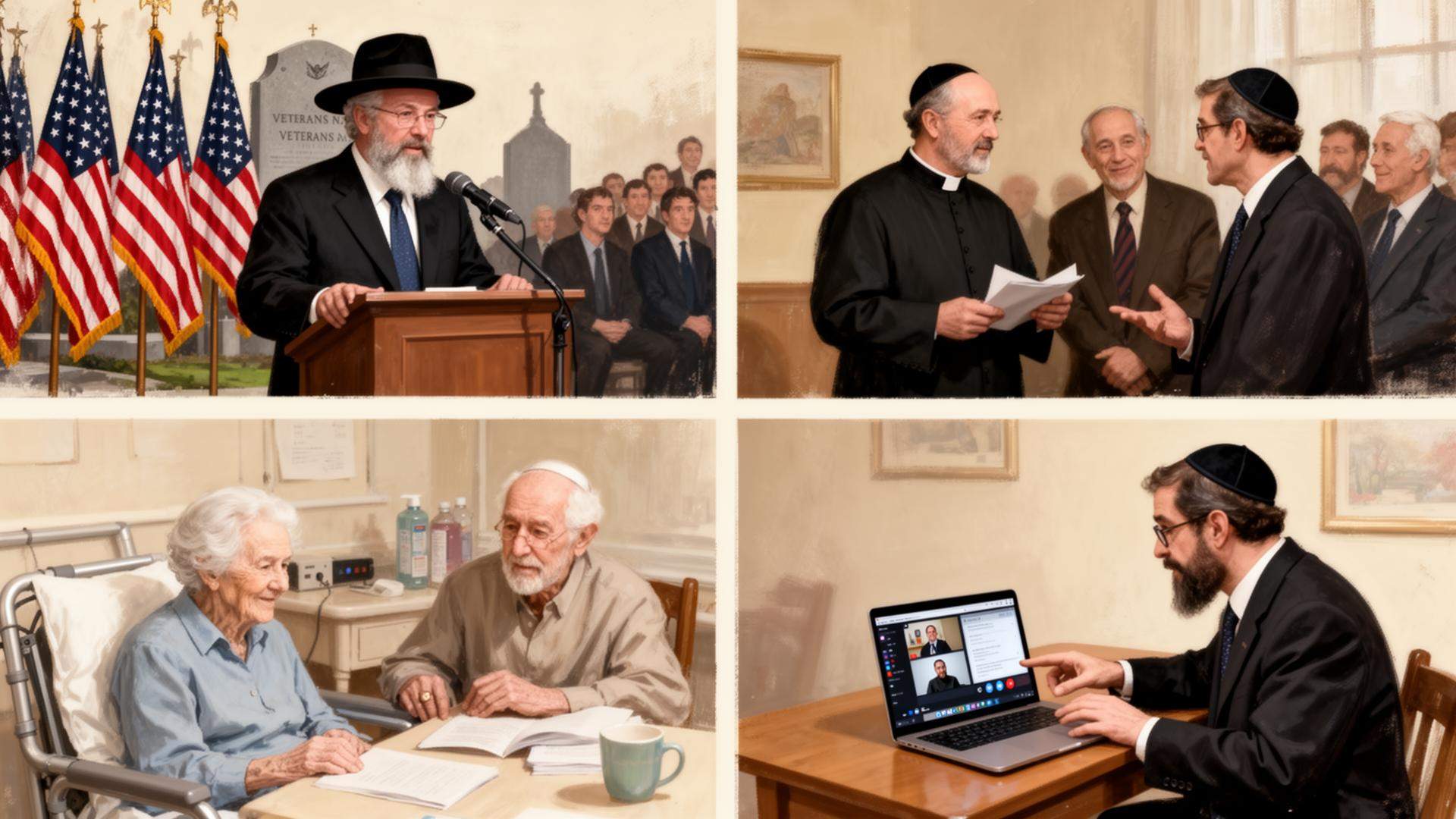
Rabbi Sayani’s sense of obligation reaches well beyond the synagogue.
He delivers invocations at 9/11 and Veterans Day commemorative events in Marine Park, Brooklyn. That regular civic presence has built genuine relationships across faith lines, including a lasting friendship with Roman Catholic Deacon Fred Ritchie. Interfaith connection built through shared public service carries a different quality than connection built in formal settings. It is grounded in showing up, consistently, for something larger than any one community. His broader civic work is explored in this feature on interfaith unity and public service.
He organizes the thrice daily recitation of the mourner’s Kaddish on behalf of the deceased. The initiative honors memory, supports Torah scholars in financial need, and creates a meaningful entry point for less affiliated Jews to reconnect with tradition. It is quiet work. It is also essential work.
His rabbinic experience includes kosher supervision and service as a nursing home chaplain. Both require the same fundamental quality. The ability to meet people exactly where they are, without judgment and without rushing. That side of his work is reflected in this profile on his nursing home chaplaincy and in this overview of his service across the tristate area.
In 2020, he led Shore Parkway Jewish Center through the aftermath of an antisemitic attack. The community needed steadiness. He provided it. ABC 7 Eyewitness News covered the incident, and his calm, supportive response demonstrated what communities need from their leaders in hard moments.
Teaching That Reaches Further
Rabbi Sayani shares his learning across multiple platforms, reaching people far beyond his congregation.
He publishes articles with The Times of Israel. He posts recorded lectures on YouTube. For those who want to explore his presentations and structured Torah content in a visual format, his channel offers an accessible collection of his work, organized and available to anyone who wants to learn. His digital teaching was also featured in this article about making Torah learning accessible.
For listeners who prefer audio, his SoundCloud profile offers Torah content that can travel with them through the day. He also shares updates and public engagement through his X profile.
This kind of public teaching reflects a conviction he carries consistently. Torah is not meant to stay behind closed doors. Making it accessible is not a departure from tradition. It is a fulfillment of it.
What This Kind of Leadership Looks Like
New York’s Jewish landscape is broad, layered, and alive with both strength and pressure. Smaller congregations carry real history and sometimes struggle to sustain it. The need for leaders who bring both deep knowledge and genuine human warmth is constant.
Rabbi Daniel Sayani fills that need in a specific and meaningful way. He did not grow up with this role waiting for him. He studied for it across multiple cities and countries. He earned the right to lead through years of learning under recognized authorities. And he leads with the openness of someone who still remembers what it felt like to stand at the beginning.
A synagogue built by Holocaust survivors deserves leadership that understands weight, memory, and responsibility. His work at Clearview Jewish Center, and throughout Brooklyn and Queens, shows that he takes all three seriously.
Chosen faith, it turns out, can run as deep as any other kind. In Rabbi Sayani’s case, it has meant a life of learning, service, and showing up, fully and consistently, for the people and the tradition he made his own.