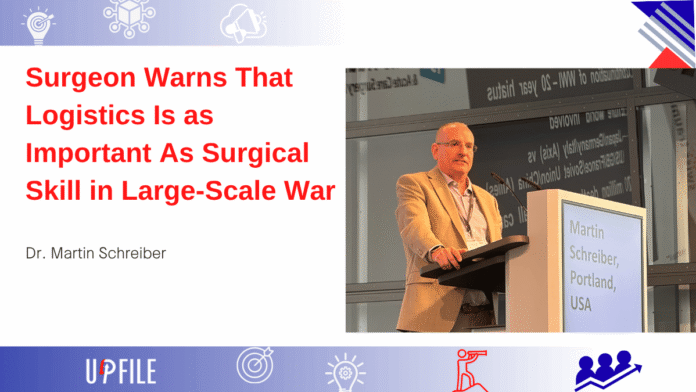

Speaking at Swiss Trauma & Acute Care Surgery Days 2026, trauma surgeon and U.S. Army Reserve Colonel Dr. Martin A. Schreiber said that in large-scale war, survival may depend as much on clinical talent as it does on the medical system’s ability to move blood, patients, and supplies under fire.
Dr. Schreiber delivered the message during a March 19 military medicine session focused on readiness for large-scale combat operations. His presentation looked at lessons from World War II and applied them to future high-intensity conflicts. The main point was straightforward: when casualty numbers climb into the hundreds of thousands, the biggest threats to survival often come from distance, broken supply lines, and delayed evacuation rather than a lack of surgical knowledge.
That argument carries added weight coming from Schreiber, who has spent years working at the intersection of civilian trauma care and military medicine. He serves as an Adjunct Professor of Surgery at the Uniformed Services University of the Health Sciences and is a Colonel in the U.S. Army Reserve. His background includes senior trauma leadership roles during deployments to Iraq and Afghanistan.
At the Bern meeting, Schreiber urged trauma leaders to think beyond the operating room. In a contested environment, he suggested, even well-trained teams can be limited by shortages of blood products, damaged transport routes, disrupted communications, and long evacuation times. The challenge is not simply whether clinicians know what to do. It is whether the system around them still functions when the battlefield stretches resources past the breaking point.
That theme shaped the larger military medicine session, which brought together U.S. and Swiss experts to examine how trauma systems respond under wartime pressure. COL Dr. Jennifer M. Gurney, Chief of the Joint Trauma System for the U.S. Army, also presented. The program included case discussions based on real U.S. war casualties, giving the session a practical focus rather than a purely theoretical one.
Schreiber then joined an international expert panel that reviewed those cases in detail. Panelists discussed how principles of trauma care change when evacuation is delayed, resources are limited, and casualty volume is high. The discussion included specialists from both U.S. and Swiss institutions, reflecting the increasingly international nature of military and civilian trauma planning.
The setting reinforced the point. The conference opened with visits to two Swiss facilities built around resilience and continuity of care: an underground hospital designed to function even during a nuclear event and a Cold War-era underground fortress. Those site visits offered a visible reminder that preparedness is not only about surgeons and protocols. It also depends on infrastructure that can survive disruption.
Major General Dr. Andreas Stettbacher, Surgeon General of the Swiss Armed Forces, hosted the session and framed the discussion within a broader view of national preparedness. From Switzerland’s perspective, protected medical infrastructure and operational continuity remain central to planning for extreme scenarios. That approach aligned closely with Schreiber’s message that medical readiness in war depends on systems that can absorb shocks and keep working.
The session comes at a time of renewed global interest in military medical readiness. Many trauma leaders are reexamining whether civilian and military systems are prepared for conflicts marked by mass casualties, extended transport times, and contested logistics. Lessons from recent wars, as well as older conflicts, have pushed planners to look again at blood distribution, forward resuscitation, prolonged field care, and the need for flexible evacuation models.
Schreiber’s remarks fit squarely within that discussion. His message was not that surgical skill matters less in absolute terms, but that skill alone is not enough. In large-scale war, outcomes may hinge on whether teams can get patients to care in time, whether blood is available when needed, and whether the system can continue operating when usual assumptions about transport and access no longer hold.
His appearance at STACS 2026 adds to a busy year of recognition and visibility in trauma medicine. It also highlights the growing overlap between military and civilian trauma systems, where lessons from combat care continue to influence planning, training, and emergency response.
Swiss Trauma & Acute Care Surgery Days remains one of the key forums for those conversations. By bringing together European and U.S. experts in trauma, critical care, and military medicine, the meeting offers a place to test ideas that may shape how health systems prepare for future crises.
At this year’s gathering, Schreiber’s warning was clear. In the next major war, the question may not be whether surgeons know how to save lives. It may be whether the system can still deliver the basics needed to let them try.