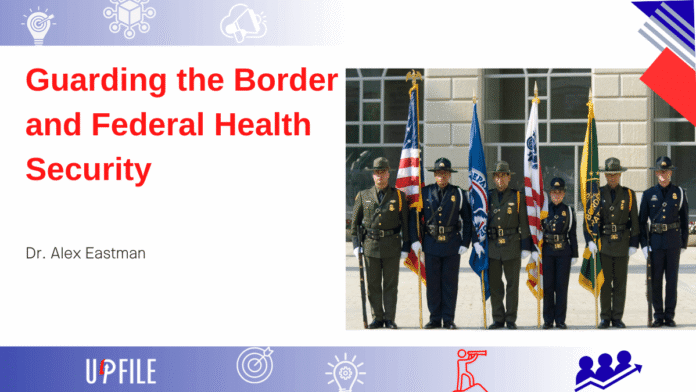

Federal health security is often discussed in broad terms. In practice, it comes down to a much simpler question: are medical systems prepared to function when conditions are difficult and resources are limited? For large federal agencies operating in remote and demanding environments, the answer to that question determines whether people get care in time or whether they do not.
U.S. Customs and Border Protection is one such environment. Personnel work long hours in extreme heat, remote terrain, and unpredictable conditions. Medical emergencies may involve employees, contractors, or individuals in custody, often far from hospital access. In these situations, outcomes depend almost entirely on preparation and clear medical oversight. That is not a policy statement. It is the practical reality of operating at scale in difficult terrain.
That reality is exactly what shaped the career of Dr. Alexander Eastman, MD, MPH, FACS, FAEMS. A board-certified trauma surgeon, surgical intensivist, and emergency medical services physician based in Dallas, Texas, Eastman has spent more than two decades working in settings where medical decisions must be made quickly and under imperfect conditions. His biography is detailed in full at his WordPress profile, and it tells the story of a physician who built his expertise in one of the hardest working trauma environments in the country before taking that expertise into federal operations.
From Parkland to Federal Operations
To understand how Dr. Eastman arrived at federal health security, it helps to understand where he trained. He completed his surgical residency and trauma fellowship at UT Southwestern Medical Center and Parkland Memorial Hospital in Dallas, one of the nation’s busiest Level I trauma centers. Parkland is not a place where trauma arrives occasionally. It is relentless, continuous, and high volume. That environment forced him to recognize patterns quickly and make decisions with incomplete information. It is a form of preparation that no conference room exercise fully replicates.
His training also extended into law enforcement. He has served with the Dallas Police Department since 2004, beginning as a Tactical Physician and eventually becoming a sworn officer, then Lieutenant, and ultimately Chief Medical Officer. As LA Progressive covered in a detailed profile of his Dallas trauma work, his dual role inside the trauma center and inside law enforcement gave him a way to understand the same medical emergencies from both sides. He knew why officers made the decisions they made on scene, and he also knew what those decisions meant once the injured arrived at the hospital. That combination shaped how he later approached federal preparedness.
This background in trauma care, emergency medical services, and public safety medicine is what prepared him for leadership roles focused on health protection and emergency readiness at scale. Read more about professionals who built careers across disciplines in the Education and Entrepreneurs sections at Up-File.
Understanding Federal Health Security in CBP Operations
Within CBP, federal health security is about whether medical systems hold up under real operating conditions. It means ensuring people have access to care when they need it, that medical decisions in custody environments are properly guided, and that teams are prepared for emergencies that may unfold far from hospitals or advanced facilities.
Much of CBP’s work happens in places where medical support is not close at hand. Long distances, harsh weather, and limited resource access all raise the stakes when something goes wrong. In those settings, outcomes depend less on ideal equipment and more on whether the system itself is prepared. Whether expectations are clear. Whether decisions are consistent. Whether medical leadership is present when it matters.
Federal health security in this context has little to do with enforcement or policy. Its purpose is to ensure that care remains ethical, timely, and reliable even when conditions are difficult. The goal is not perfection. It is stability: medical systems that continue to function when circumstances are far from controlled. This is a core principle across global healthcare leadership and one Dr. Eastman has applied at every level of his career.
Dr. Eastman’s Role Within CBP
From June 2023 through December 2024, Dr. Eastman served as Acting Chief Medical Officer for U.S. Customs and Border Protection. During that period, he also held a Customs Officer designation with law enforcement authority, a reflection of the operational nature of the role. His full professional profile is available at OurFeatured.
His responsibilities during this period were clearly bounded to healthcare oversight. He provided medical guidance to CBP executives, led the Border Health System to protect individuals in custody against health hazards, protected CBP employees from occupational health risks, and provided medical oversight to ensure the delivery of consistent care across a complex, geographically distributed organization. He developed and implemented strategic programs in collaboration with DHS headquarters and operational components, and guided senior leadership on medical strategy development and implementation.
His authority was medical in nature. It did not extend to enforcement activity, operational decisions unrelated to health, or immigration policy. His role existed to ensure that health-related decisions were grounded in established medical practice rather than ad hoc judgment, regardless of what operational pressures existed at any given moment.
In this capacity, Eastman functioned as a medical steward. His responsibility was to support ethical, reliable healthcare delivery and to ensure that medical systems within CBP operated within defined standards. That standard applied equally to personnel and to individuals in custody.
Why Emergency Preparedness Matters at the Federal Level
Preparedness, in practical terms, is about whether medical systems can function when conditions are strained. It requires clear guidance for decision-making, people trained to work under pressure, and systems that continue operating when information is incomplete or access is limited. Weak points tend to appear during handoffs, in remote locations, or when situations evolve faster than plans anticipate.
Dr. Eastman’s approach treats preparedness as ongoing work rather than a fixed state. It involves constant adjustment. Training based on real events. Reviewing how systems perform under stress. Refining processes before failures recur. When medical leadership is involved early, responses tend to be more consistent, safer for those involved, and better matched to the realities faced by personnel in the field.
This thinking connects directly to his earlier work on the Hartford Consensus, the national initiative that brought together trauma surgeons and public safety officials to rethink the earliest minutes of mass casualty response. That effort produced the Stop the Bleed campaign, a national program training civilians and first responders in immediate hemorrhage control. The core lesson Eastman carried from that work into federal service is the same one he saw at Parkland: early action changes outcomes, and systems that wait for ideal conditions lose people who could have been saved.
Applying Frontline Experience to National Preparedness
Eastman’s federal work is shaped by experience gained outside Washington. His background in trauma care, EMS, and public safety medicine in Dallas informs how he approaches preparedness at the national level.
Frontline work exposes where systems succeed and where they fail. It shows how quickly conditions change, how often information is incomplete, and how early decisions shape outcomes. That experience carries into federal planning by grounding preparedness efforts in what actually happens during emergencies, rather than what is assumed to happen.
His contribution is based on translating lessons learned at the local level into systems that can function across a national organization, without relying on ideal conditions or perfect information. His prior role as Supervisory Medical Officer for the HHS International Medical/Surgical Response Team-West, from April 2010 to June 2022, gave him additional preparation for exactly this kind of multi-jurisdictional, resource-constrained medical leadership.
Discussions of his preparedness work and career philosophy are also available through his Spotify channel, where those interested in the intersection of trauma medicine and public safety can hear more about the frameworks he has developed over two decades.
How Medical Leadership Changes the System
The most significant impact of structured medical leadership in a federal agency is structural rather than individual. When medical decision-making moves from being situational and fragmented toward being clearly defined and consistently applied, it changes how the entire organization behaves during a crisis.
Before that shift, medical guidance in large field operations could vary depending on location, circumstance, or who happened to be involved at the moment. Clear medical authority, shared standards, and alignment between medical judgment and operational realities reduce that variability. The goal is not additional layers of bureaucracy. It is to reduce uncertainty about how health decisions should be made when time and information are limited.
Medical oversight becomes part of how operations are planned and executed, rather than something consulted after problems arise. Over time, that consistency reduces reliance on improvisation and helps medical decisions hold up even when conditions are unpredictable. This is what the most significant public sector health stories share in common: systems that outlast the individuals who built them.
From Individual Leadership to Institutional Change
System change only matters if it lasts beyond one person. The deeper contribution of embedded medical leadership is continuity. Standards remain in place as personnel rotate. Expectations are clearer across teams. Decisions rely less on personal judgment and more on shared medical guidance already established.
At the federal level, large organizations cannot depend on informal processes or individual experience alone. Institutional change happens when leadership results in systems that function consistently regardless of who is on duty or where operations are taking place. That shift from individual expertise to durable medical governance is what defines the difference between a capable physician and a transformational medical leader.
Dr. Eastman’s current role as Senior Medical Officer for Operations at the U.S. Department of Homeland Security Office of Health Security, which he has held since July 2022, reflects this progression. He serves as an executive team member leading the overall medical, health, and safety vision for the organization, serves as DHS EMS Medical Director, provides protective medicine expertise to DHS principals, and develops strategic programs in collaboration with operational components and business partners across the federal enterprise.
For more coverage of leadership profiles and public sector healthcare at this level, visit the Featured section at Up-File.
The Purpose of Medical Leadership in High-Stakes Environments
The purpose of medical leadership in federal agencies is not visibility or rapid response. It is stability. When leadership helps systems behave predictably under pressure, it reshapes how care is delivered long after individual decisions fade from view.
Through his roles within CBP and DHS, Dr. Eastman’s impact is best measured not by isolated outcomes but by how medical oversight became more clearly integrated into these organizations. That kind of leadership does not seek attention. It strengthens the system so that when it is tested, it holds.
That is how federal health security evolves: not through individual acts, but through leadership that changes how decisions are made, every day.
Learn more about Dr. Alexander Eastman at dralexandereastman.com and connect with him on LinkedIn. His publications and research record are available at dralexandereastman.com/publications.